Understanding the Big Bang Theory

How Science Fiction Became Scientific Fact About Our Universe
The Big Bang Theory stands as one of the most profound scientific achievements in human history, explaining how our vast universe came into existence approximately 13.8 billion years ago. What might have once seemed like pure science fiction has become our best understanding of cosmic reality, supported by decades of astronomical observations and theoretical physics. The story of how we discovered the universe’s origins reads almost like a sci-fi thriller, complete with mysterious radiation, expanding galaxies, and a moment of creation so intense that it defies ordinary imagination. For anyone who has ever looked up at the night sky and wondered how it all began, understanding the Big Bang Theory provides answers that are both scientifically rigorous and deeply awe-inspiring.
The journey to understanding the universe began not with a telescope but with an idea. In 1927, Belgian physicist and priest Georges Lemaître proposed something revolutionary: that the entire cosmos originated from what he called a “primeval atom.” This concept suggested that everything we see today—every star, planet, and galaxy—was once compressed into an infinitely small, infinitely dense point. Two years later, Edwin Hubble made observations that would validate Lemaître’s theory, discovering that distant galaxies were moving away from us and that the farther away they were, the faster they moved. This wasn’t random motion but systematic expansion, suggesting that the entire fabric of space itself was stretching. The implications were staggering: if everything was moving apart now, then working backward through time meant everything must have once been together in one place.

Credit: Unsplash – Cosmic representation of universe expansion
The actual mechanics of the Big Bang are more complex and fascinating than any science fiction writer could have imagined. At time zero, there was no “place” for the explosion to happen in—space and time themselves came into existence with the Big Bang. The initial moment was characterized by temperatures exceeding 10 billion degrees Fahrenheit, where matter as we know it couldn’t exist. Instead, the universe consisted of fundamental particles and pure energy in a state of extreme chaos. Within the first fraction of a second, something extraordinary happened: cosmic inflation. During an incredibly brief period lasting about 10^-32 seconds, the universe expanded exponentially faster than the speed of light. This rapid inflation solved several cosmological puzzles, including why the universe appears so uniform in all directions and why space seems geometrically flat rather than curved.
The Evidence That Proves Our Universe Had a Beginning
Scientific theories require evidence, and the Big Bang Theory is supported by multiple independent lines of observation that make it one of the most well-established concepts in modern physics. The first major piece of evidence comes from the cosmic microwave background radiation, discovered accidentally in 1964 by Arno Penzias and Robert Wilson. This faint glow permeates every corner of space, representing the “afterglow” of the Big Bang cooled down over billions of years to just 2.7 degrees above absolute zero. What makes this discovery so compelling is that the Big Bang Theory predicted this radiation should exist before it was ever detected. The uniformity of this background radiation across the entire sky confirms that the early universe was remarkably homogeneous, exactly as the theory suggests it should have been shortly after the initial expansion began.
Beyond the microwave background, astronomers have gathered extensive evidence from studying the composition of the universe. The Big Bang Theory makes specific predictions about the abundance of light elements like hydrogen, helium, and lithium that should have formed in the first few minutes after creation. When scientists measure the ratios of these elements throughout the cosmos, they match the theoretical predictions with stunning accuracy. Additionally, the large-scale structure of the universe, how galaxies cluster together in vast cosmic webs, aligns with computer simulations based on Big Bang cosmology. Perhaps most convincingly, every time astronomers look deeper into space with powerful telescopes, they’re also looking back in time because light takes time to travel across cosmic distances. These observations show the universe was denser, hotter, and filled with younger galaxies in the past, exactly as an expanding universe model predicts.
From Hot Particles to Stars and Galaxies: The Universe’s Evolution
The transformation of the early universe from a chaotic soup of particles into the ordered cosmos we observe today represents one of nature’s most remarkable stories. In the first three minutes after the Big Bang, the universe cooled enough for protons and neutrons to combine into the nuclei of light elements, primarily hydrogen and helium. However, the universe was still too hot for complete atoms to form, electrons couldn’t settle into stable orbits around nuclei because intense radiation kept knocking them free. This created an opaque fog where light couldn’t travel far before being scattered. Only after about 380,000 years did the universe cool sufficiently for electrons and nuclei to combine into neutral atoms, an event cosmologists call “recombination.” At this moment, the universe became transparent, and light could finally travel freely through space, this is the light we now detect as the cosmic microwave background radiation.
The formation of the first stars represents another critical milestone in cosmic evolution. For hundreds of millions of years after recombination, the universe entered what astronomers call the “cosmic dark ages”, a period when no stars yet existed to illuminate space. Eventually, gravity caused slight density variations in the hydrogen and helium gas to amplify, pulling matter together into increasingly dense clouds. When these clouds reached critical mass and temperature, nuclear fusion ignited, and the first stars blazed to life. These primordial stars were massive monsters, perhaps hundreds of times larger than our Sun, and they lived fast and died young in spectacular supernova explosions. These explosions forged heavier elements like carbon, oxygen, and iron, the building blocks necessary for planets and eventually life. Successive generations of stars continued this elemental enrichment, while gravity simultaneously pulled stars together into galaxies, which themselves clustered into the vast cosmic web structure we observe throughout the universe today.
Dark Energy and the Accelerating Universe Mystery
One of the most surprising discoveries in cosmology came in the late 1990s when astronomers studying distant supernovae made an unexpected observation: the expansion of the universe isn’t slowing down as expected but is actually accelerating. This finding was so unexpected and important that it earned its discoverers the 2011 Nobel Prize in Physics. According to the Einstein-de Sitter model that had dominated cosmology for decades, the universe should gradually decelerate due to gravitational attraction between all matter. The acceleration discovery forced scientists to confront the existence of “dark energy”, a mysterious force that appears to push space apart rather than pull it together. Current measurements suggest that approximately 73% of the total energy density of the universe consists of this dark energy, while dark matter comprises about 23%, and ordinary matter that makes up everything we can see accounts for only about 4%.
The nature of dark energy remains one of the biggest unsolved mysteries in physics. The leading candidate is Einstein’s cosmological constant, a property of space itself that imbues empty space with energy. Einstein originally introduced this constant into his equations in 1917 to keep the universe static, only to abandon it when Hubble discovered cosmic expansion. In a twist of cosmic irony, the constant had to be reintroduced to explain the accelerating expansion, though with a different value than Einstein originally proposed. Recent research in 2025 has challenged even this understanding, with some scientists proposing that dark energy may not be constant but could be evolving over time, potentially driven by exotic particles called axions. These new models suggest the universe’s acceleration might eventually reverse, leading to a “Big Crunch” billions of years in the future where everything collapses back together. Understanding dark energy isn’t just academic curiosity—it determines the ultimate fate of our universe and everything within it.
Challenges to the Big Bang Theory and Alternative Models
While the Big Bang Theory enjoys overwhelming support from the scientific community, it’s not without challenges and competitors. Recent observations from the James Webb Space Telescope have revealed mature, fully-formed galaxies existing much earlier in cosmic history than the Big Bang model predicted. These galaxies appear surprisingly large and structured for objects that should have formed only a few hundred million years after the universe began. Some scientists interpret these findings as evidence that our current cosmological timeline might need revision, while others propose modifications to the inflation theory to accommodate the observations. Additionally, there’s growing discussion about the “Hubble tension”, a discrepancy between different methods of measuring the universe’s expansion rate that yields values that don’t quite match, suggesting either measurement errors or gaps in our understanding of how the universe evolved.
Alternative cosmological models continue to be proposed and debated within the scientific community. The “Tired Light” theory, originally suggested in the 1920s and largely abandoned, has seen renewed interest from some researchers who argue it might better explain certain observations than the standard Big Bang model. This theory proposes that light loses energy as it travels across cosmic distances, causing redshift without requiring universal expansion. However, the Tired Light model struggles to explain many phenomena that the Big Bang Theory handles elegantly, particularly the cosmic microwave background radiation and the abundance of light elements. Another intriguing proposal suggests the universe might be cyclical, going through infinite cycles of expansion and contraction, each Big Crunch followed by a new Big Bang. A July 2025 study even proposed “inflation without an inflaton,” suggesting that gravitational waves themselves could explain cosmic inflation without requiring hypothetical inflation particles. These alternative models remind us that science remains a dynamic process where new evidence can always refine or even revolutionize our understanding.
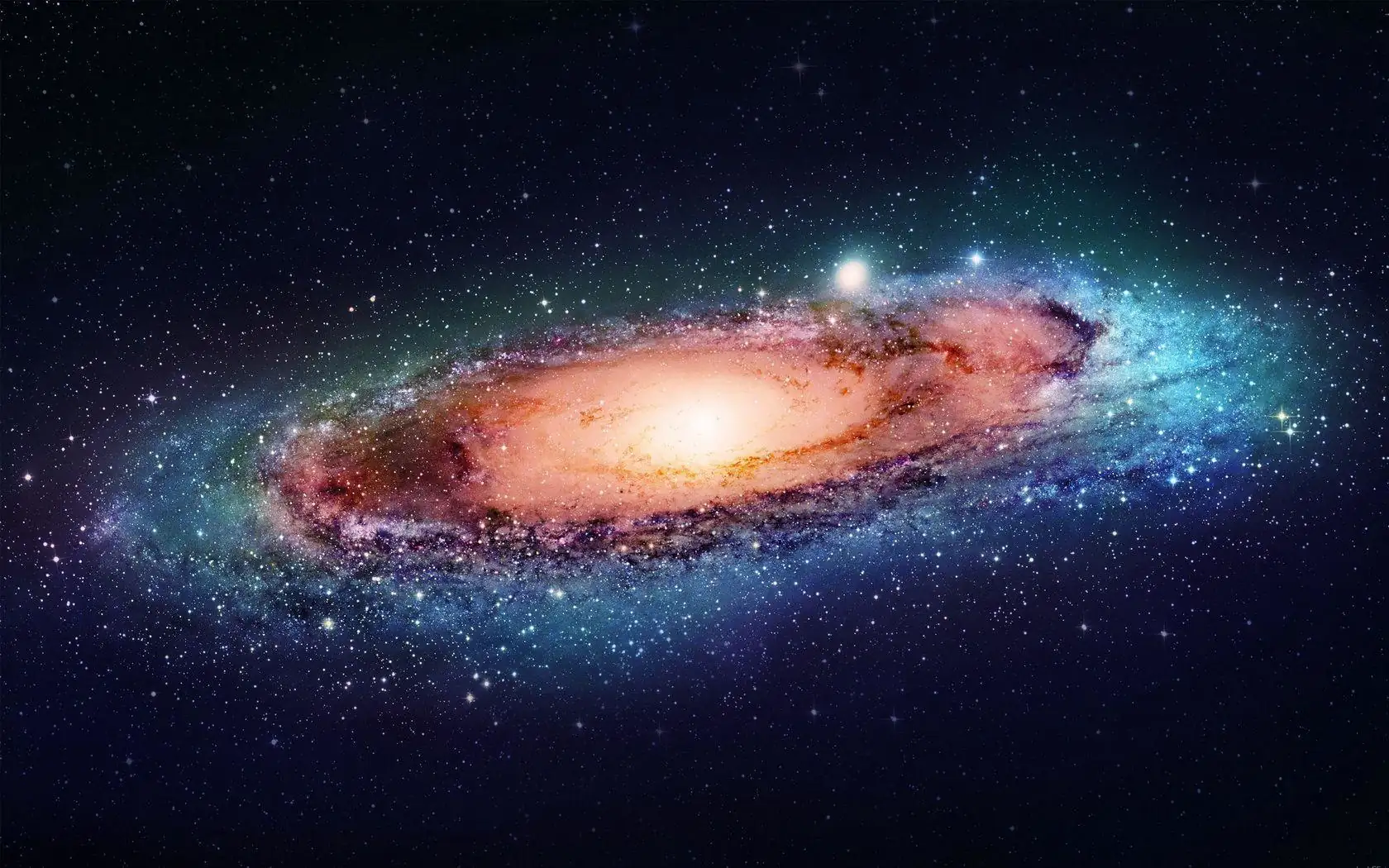
credit: https://wallpaperaccess.com/cosmos-universe
What the Big Bang Means for Science Fiction and Our Future
The Big Bang Theory has profoundly influenced science fiction and our broader cultural imagination about the universe. Writers and creators have drawn inspiration from cosmology’s mind-bending concepts, parallel universes, the multiverse, time dilation near black holes, and the possibility of cosmic cycles. What makes the Big Bang particularly fascinating for sci-fi narratives is that it establishes both origins and limits: we can trace cosmic history back 13.8 billion years but cannot scientifically know what, if anything, came before. This boundary between knowledge and mystery provides fertile ground for speculative fiction. The theory also raises profound philosophical questions about causation, the nature of time, and whether our universe is unique or one of countless others in a vast multiverse. These aren’t just abstract concepts, they challenge us to think about our place in an almost incomprehensibly vast cosmos.
Looking forward, ongoing research continues to refine our understanding of the Big Bang and its implications. Next-generation telescopes and experiments are being designed to detect primordial gravitational waves, ripples in spacetime from the inflation epoch that could provide direct evidence of the universe’s first moments. Scientists are also working to better understand dark energy and dark matter, the mysterious components that dominate the universe but remain poorly understood. Some researchers are even exploring whether information about what happened before the Big Bang might somehow be encoded in observable cosmic structures. As our observational capabilities improve and theoretical physics advances, we can expect our picture of cosmic origins to become increasingly detailed and potentially more surprising. The story of the universe that seemed like science fiction a century ago is now established science, yet it continues to evolve as new discoveries challenge and expand our understanding of reality itself.
Frequently Asked Questions About the Big Bang Theory
- What exactly caused the Big Bang to happen?This remains one of the biggest unanswered questions in cosmology. The Big Bang Theory describes what happened after the initial expansion began, but it cannot explain what triggered it or what, if anything, existed beforehand. Some theories propose quantum fluctuations in a pre-existing state, others suggest our universe budded off from a parent universe, and some argue the question itself may not be meaningful since time began with the Big Bang. Currently, we lack both the observational evidence and theoretical framework to answer definitively what caused the initial expansion.
- Was there really an explosion at the beginning of the universe?The term “Big Bang” is somewhat misleading because it suggests an explosion that happened in space. In reality, the Big Bang represents the expansion of space itself from an infinitely dense point. There was no pre-existing space for an explosion to occur in, space, time, and matter all came into existence simultaneously. Rather than an explosion into empty space, imagine every point in space stretching away from every other point, like dots on an inflating balloon surface.
- How do scientists know the universe is 13.8 billion years old?This age comes from multiple independent measurements that all converge on approximately the same value. The primary method involves measuring the cosmic microwave background radiation and analyzing its properties, which reveal conditions in the early universe. Scientists also measure the expansion rate using distant supernovae and calculate backward to determine when everything would have been at a single point. Additionally, studying the oldest stars and radioactive decay rates in ancient materials provides consistent age estimates.
- What existed before the Big Bang?This question may not have a meaningful answer within our current understanding of physics. Since time itself began with the Big Bang, asking what came “before” is like asking what’s north of the North Pole—the question assumes something that doesn’t exist. However, some theoretical frameworks like eternal inflation or the multiverse hypothesis suggest our Big Bang might be one event in a larger structure where “before” could have meaning. Currently, we have no way to test these ideas empirically.
- Will the universe expand forever or eventually collapse?Based on current observations showing accelerating expansion driven by dark energy, the universe appears headed for eternal expansion, growing increasingly cold and empty over trillions of years in what’s called “heat death.” However, recent 2025 research suggests dark energy might not be constant, raising the possibility that expansion could eventually reverse, leading to a “Big Crunch” where everything collapses back together. Our understanding of dark energy remains incomplete, so the ultimate fate of the universe is still uncertain.
- Could the Big Bang Theory be wrong?While no scientific theory is ever proven absolutely true, the Big Bang Theory is supported by such extensive and diverse evidence that its basic framework is highly unlikely to be wrong. That said, the theory continues to be refined as new observations reveal details about the early universe. Recent discoveries have challenged specific predictions and timelines, but these generally lead to modifications and improvements rather than wholesale rejection. Science progresses by questioning and testing theories, so ongoing scrutiny actually strengthens our confidence in well-supported models.
- How does the Big Bang Theory relate to the possibility of life elsewhere in the universe?The Big Bang Theory establishes that the universe has been around long enough and is vast enough for countless stars and planets to form, dramatically increasing the statistical likelihood of life arising elsewhere. The theory also explains how heavier elements necessary for life were forged in early generations of stars and distributed throughout space via supernovae. Understanding cosmic evolution helps scientists identify which planetary systems might be hospitable to life and how long life has had to develop in different parts of the universe, informing the search for extraterrestrial intelligence.
credit image cover: https://unsplash.com/pt-br/fotografias/galaxia-0o_GEzyargo
Foto de Shot by Cerqueira na Unsplash
Important
I really like these topics: astronomy, science fiction, humanoids, civilizations, etc., so I decided to write about them, and of course with the help of AI only for the launch of the blog. After launching it, I will only use AI for English correction and other things; I will write the content myself.
Sources:
- https://pt.wikipedia.org/wiki/The_Big_Bang_Theory
- https://en.wikipedia.org/wiki/Big_Bang
- https://www.uwa.edu.au/study/-/media/Faculties/Science/Docs/Evidence-for-the-Big-Bang.pdf
- https://www.britannica.com/video/History-model/-163771
- https://www.astronomy.com/science/the-science-behind-the-big-bang-theory/
What aspects of the Big Bang Theory fascinate you most? Do you think future discoveries will fundamentally change our understanding of cosmic origins, or will the basic framework remain intact? Share your thoughts and questions in the comments below, I’d love to hear your perspective on how science continues to unravel the universe’s deepest mysteries!

HJunior
I am Humberto Junior, SEO Writer, Copywriter, and enthusiastic and passionate about technology, future blockchain programmer. Facebook Twitter LinkedIn Instagram Youtube Edit Template