Real Scientific Discoveries: That Changed Our Understanding of the Universe

Real Scientific Discoveries That Changed Our Understanding of the Universe
When we think about the breakthroughs that have reshaped humanity’s grasp of the cosmos, few missions stand out quite like the work done by NASA and the European Space Agency’s collaborative efforts. The universe has always held mysteries that seemed almost impossible to unravel, but through dedicated space observatories and cutting-edge technology, scientists have been peeling back layers of cosmic secrets one discovery at a time. Among these groundbreaking missions, the Herschel Space Observatory emerged as a titan of infrared astronomy, fundamentally changing how we understand star formation, molecular chemistry, and the very building blocks of life itself. This wasn’t just another telescope floating in space but rather a revolutionary instrument that gave us eyes to see what had been invisible for millennia.
The Herschel Space Observatory, launched in May 2009, represented a collaboration between NASA and the European Space Agency that would yield discoveries far beyond anyone’s initial expectations. With its massive 3.5-meter mirror made of silicon carbide, it became the largest infrared telescope ever deployed in space at that time. What made the Herschel Space Observatory particularly special was its ability to detect far-infrared and submillimeter wavelengths, allowing scientists to peer through cosmic dust clouds that had previously obscured our view of star-forming regions. During its nearly four-year operational lifetime, this remarkable observatory collected approximately 26,000 hours of unprecedented data, fundamentally transforming multiple fields of astronomy and planetary science.
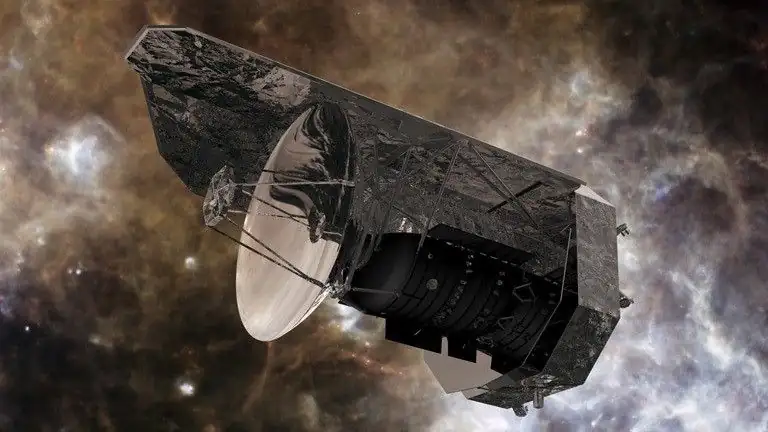
Herschel was an infrared space telescope that made important discoveries and vital contributions to almost every field of astronomy and planetary science. Herschel’s main discoveries involved star formation, both in our Milky Way galaxy and in galaxies throughout cosmic history, and of key molecules – among them, water – that have made their way from interstellar clouds to burgeoning planetary systems.
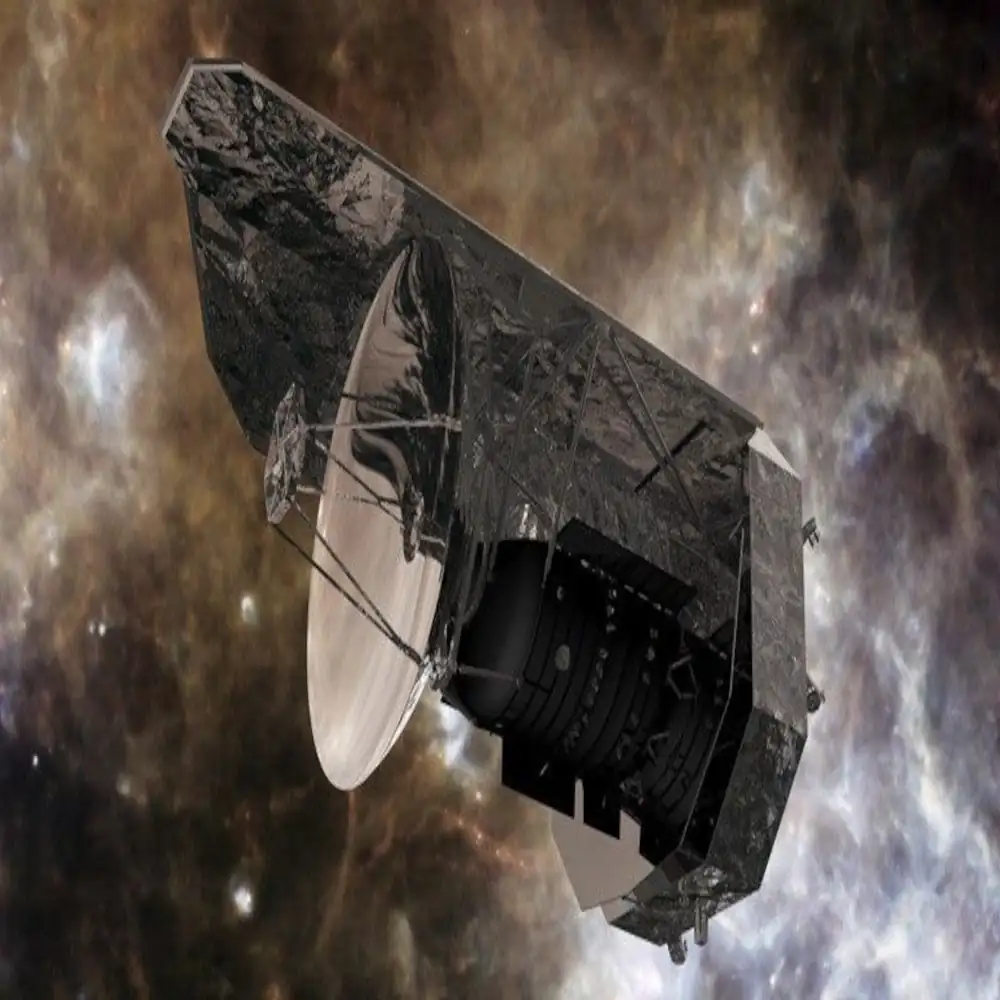
An illustration of Herschel in space. – › Full Image and Caption (ESA)
ESA/Herschel/NASA/JPL-Caltech; acknowledgment T. Pyle & R. Hurt (JPL-Caltech)
Image Credit: ESA/Herschel/NASA
How the Herschel Space Observatory Revolutionized Our Understanding of Water in Space
One of the most profound contributions made by the Herschel Space Observatory involved tracing the cosmic water trail throughout our galaxy and beyond. Water, the essential molecule for life as we know it, had been detected in various cosmic locations before, but never with the precision and comprehensive coverage that Herschel provided. The observatory’s Heterodyne Instrument for the Far Infrared, or HIFI, became instrumental in this quest. Scientists working with data from NASA and ESA collaborations discovered water molecules in places that challenged previous assumptions about where and how this vital substance forms in space.
The Herschel Space Observatory detected water vapor in star-forming molecular clouds for the first time in pre-stellar cores, those cold lumps of dense material that eventually collapse to form new stars. This discovery was revolutionary because it showed that water exists even before stars ignite their nuclear furnaces. Furthermore, researchers found water in the seeds of future planetary systems, suggesting that planets might be born already possessing the ingredients necessary for life. The observatory also identified how water gets delivered from interplanetary debris to planets within our solar system, providing crucial insights into Earth’s own water origin story.
Perhaps one of the most intriguing findings came from Herschel Space Observatory observations of Comet Hartley 2. The data revealed that the deuterium-to-hydrogen ratio in the comet’s water closely matched Earth’s oceans, supporting the theory that comets may have delivered significant amounts of water to our planet billions of years ago. Although this particular theory has been somewhat contested by subsequent research, it opened up fascinating debates about the origins of Earth’s oceans. NASA scientists also used Herschel Space Observatory data to confirm water vapor on Ceres, the dwarf planet residing in the asteroid belt, marking the first detection of water in that region and predating the arrival of NASA’s Dawn mission.
Unveiling the Secrets of Star Formation Through Infrared Eyes
Beyond water, the Herschel Space Observatory made groundbreaking discoveries about how stars actually form. The observatory captured stunning images revealing intricate networks of filamentary structures within cold molecular clouds throughout the Milky Way galaxy. These filaments, which appear as cosmic cobwebs stretching across space, turned out to be fundamental to understanding stellar birth. Scientists discovered that these structures aren’t random but rather form through turbulence in the interstellar medium, creating the perfect conditions for gravity to pull matter together and eventually form new stars.
The data from NASA and ESA’s joint mission showed that star formation occurs more efficiently along these filaments than previously thought. The Herschel Space Observatory found high-mass protostars forming in ionized regions of our galaxy, capturing early phases of stellar evolution that had been largely hidden from view until then. These observations helped scientists understand why stars form at different rates in different regions of galaxies and how the process has changed throughout cosmic history. The telescope’s ability to see through dust clouds meant that researchers could finally witness the actual moment when dense cores begin their transformation into blazing stars.
What makes these real scientific discoveries particularly valuable is that they don’t just apply to our own galaxy. The Herschel Space Observatory peered back in time to observe star-forming galaxies from when the universe was less than a billion years old. These ancient galaxies were producing stars at rates roughly ten times faster than modern galaxies, and understanding why helps astronomers piece together the cosmic story of how galaxies like our Milky Way came to exist. One particularly remarkable discovery involved identifying a starburst galaxy that produced over 2,000 solar masses worth of stars per year, originating just 880 million years after the Big Bang.
Molecular Discoveries That Redefined Space Chemistry
The real scientific discoveries made by the Herschel Space Observatory extended deep into the realm of molecular chemistry. In August 2011, mission scientists reported definitively confirming the presence of molecular oxygen in the Orion molecular cloud complex. This might sound simple, but detecting molecular oxygen in space had proven remarkably difficult despite being the third most abundant element in the universe. The confirmation provided crucial insights into how oxygen behaves in different cosmic environments and why it’s so rarely found in molecular form despite its abundance.
NASA researchers working with Herschel Space Observatory data also made progress understanding complex organic molecules in space. The observatory detected various carbon-based compounds that serve as building blocks for more complex chemistry, potentially including the precursors to life. By examining the chemical composition of atmospheres and surfaces of solar system bodies, including planets, comets, and moons, scientists began constructing a more complete picture of how the ingredients for life spread throughout our cosmic neighborhood.
The telescope’s spectroscopic capabilities allowed researchers to identify molecular fingerprints with unprecedented precision. Each molecule leaves distinctive lines in the spectrum of light, like a unique barcode, and the Herschel Space Observatory could read these barcodes across vast distances. This capability proved invaluable for understanding not just what molecules exist in space but also their concentrations, temperatures, and movements. Such detailed information helps scientists model how chemistry evolves from simple atoms in the aftermath of the Big Bang to the complex organic compounds that might eventually lead to life.
Recent Scientific Breakthroughs Building on Herschel’s Legacy
While the Herschel Space Observatory completed its mission in 2013 when it exhausted its liquid helium coolant, the legacy of real scientific discoveries continues to grow. Scientists are still analyzing the vast datasets returned by the mission, with new papers being published regularly. The observatory’s contributions have become so fundamental to astronomy that researchers often simply refer to “far-infrared data” with the implicit understanding that it comes from Herschel. This testament to the mission’s success shows how thoroughly it transformed the field.
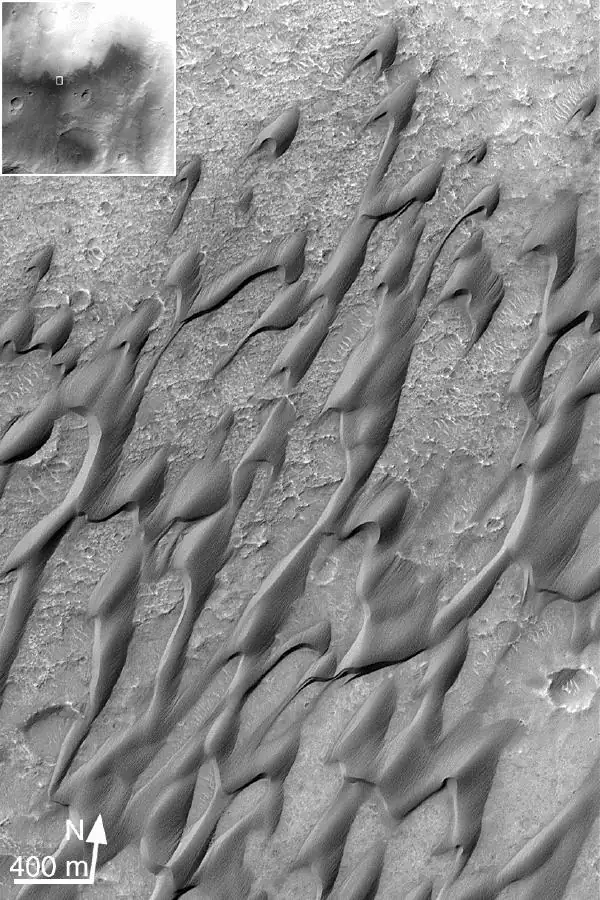
Image Credit: ESA/Herschel/NASA
Recent real scientific discoveries in 2024 and 2025 have continued building on Herschel’s foundation. NASA’s James Webb Space Telescope, which launched in 2021, has taken infrared astronomy even further. Webb discovered the most distant known galaxy, existing just 290 million years after the Big Bang, with techniques partially inspired by methods pioneered during the Herschel Space Observatory mission. The synergy between different space missions demonstrates how each discovery builds upon previous work, creating an ever-expanding understanding of our universe.
Other recent breakthroughs include advancements in understanding antimatter, quantum computing achievements that enable better error correction, and discoveries about how AI systems can accelerate scientific research itself. In the medical field, scientists developed new HIV prevention drugs that could protect people for six months with a single injection, representing a potential game-changer in ending the AIDS epidemic. Meanwhile, researchers working with nuclear fusion achieved new record-holding plasma containment times, bringing humanity closer to clean, virtually limitless energy.
The field of planetary science has also seen remarkable progress. NASA’s Perseverance rover on Mars discovered rock formations with features that, on Earth, would be associated with ancient microbial life. While this doesn’t confirm life on Mars, it raises tantalizing possibilities that future sample return missions might resolve. Additionally, astronomers confirmed the detection of a sub-Earth-mass planet orbiting Barnard’s Star, one of our closest stellar neighbors, expanding the catalog of potentially interesting worlds to explore.
The Human Element Behind Scientific Discovery
Behind every real scientific discovery stands a community of dedicated researchers, engineers, and support staff who make these breakthroughs possible. The Herschel Space Observatory mission involved ten countries, including significant contributions from NASA, demonstrating the power of international collaboration in advancing human knowledge. The mission didn’t just produce data but also trained a generation of astronomers who learned their craft analyzing Herschel observations. Many of these scientists have gone on to lead other missions and continue pushing the boundaries of what we can learn about the cosmos.
The technical achievements required to make Herschel work were themselves remarkable. The mirror had to be manufactured from silicon carbide, ground to incredible precision, and coated using vacuum deposition techniques. The entire system needed to be cooled to approximately 1.4 Kelvin using over 2,300 liters of liquid helium, creating an environment just slightly warmer than absolute zero. This extreme cooling was necessary to prevent the telescope’s own heat from overwhelming the faint infrared signals it was trying to detect from distant cosmic sources.
NASA and ESA engineers designed the mission to operate at the Sun-Earth L2 Lagrange point, approximately 1.5 million kilometers from Earth. This special location, where gravitational forces balance in a way that allows spacecraft to maintain stable positions with minimal fuel use, provided an ideal observing platform. The Herschel Space Observatory followed a Lissajous orbit around L2, communicating with ground control for three hours daily while spending the remaining time conducting scientific observations. This operational efficiency maximized the scientific return from the mission’s limited lifetime.
What These Discoveries Mean for Our Future
The real scientific discoveries made by missions like the Herschel Space Observatory don’t just satisfy curiosity but often lead to practical applications. Understanding how molecules form in space informs chemistry research on Earth. Insights into star formation help us comprehend our own solar system’s origins, which in turn guides our search for potentially habitable exoplanets. The technical innovations required for space missions frequently spin off into other industries, from medical imaging to telecommunications.
Looking forward, scientists are already planning next-generation infrared observatories that will build on Herschel’s achievements. Projects like the proposed SPICA mission would push even deeper into the far-infrared spectrum, potentially revealing phenomena that remain hidden even from our current best instruments. NASA continues advancing infrared astronomy through missions like the James Webb Space Telescope and planned future observatories. Each generation of instruments answers old questions while raising new ones, driving the endless cycle of discovery that defines science.
The search for life beyond Earth remains one of astronomy’s most compelling goals, and the Herschel Space Observatory contributed essential pieces to this puzzle. By mapping where water exists throughout the galaxy and understanding how complex molecules form, scientists can better target their searches for biosignatures on exoplanets. Future missions will look for combinations of molecules that might indicate biological processes, using techniques refined through decades of infrared spectroscopy exemplified by Herschel’s work.
Climate science also benefits from the techniques developed for space-based infrared observations. The same technologies that allow astronomers to measure temperatures and chemical compositions of distant molecular clouds can be adapted to monitor Earth’s atmosphere, tracking greenhouse gases and understanding climate dynamics. This cross-pollination between space science and Earth science demonstrates how fundamental research often yields unexpected practical benefits.
The Broader Impact of Real Scientific Discoveries
Real scientific discoveries have a way of challenging our assumptions and expanding our horizons. When the Herschel Space Observatory began operations, scientists expected to learn more about star formation and molecular chemistry. They got that and so much more, uncovering unexpected phenomena and raising new questions that will occupy researchers for generations. This pattern repeats throughout the history of science where instruments designed to answer specific questions often make their most important contributions through serendipitous discoveries that nobody anticipated.
The data from NASA and ESA collaborations like Herschel also demonstrate the importance of open science. The mission’s datasets were made available to the global scientific community, enabling researchers worldwide to make discoveries using observations they didn’t personally conduct. This democratization of data amplifies the return on investment in space missions, as hundreds of research groups can extract insights from the same observations, approaching the data with different questions and perspectives.
Education represents another crucial dimension of these discoveries. Images from the Herschel Space Observatory have inspired countless students to pursue careers in science, technology, engineering, and mathematics. The mission’s achievements demonstrate that humanity can undertake ambitious projects requiring international cooperation, advanced technology, and years of patient work to answer fundamental questions about nature. In an era when complex problems require similar levels of dedication and collaboration, these scientific endeavors serve as proof that such efforts can succeed.
The philosophical implications of real scientific discoveries about the universe’s chemical richness and the ubiquity of star-forming regions suggest that planets, and possibly life, might be far more common than once thought. While we haven’t yet found definitive evidence of extraterrestrial life, missions like Herschel show that the ingredients and conditions necessary for life exist throughout the galaxy. This knowledge reshapes how we think about humanity’s place in the cosmos and our relationship with the universe at large.
Frequently Asked Questions About Real Scientific Discoveries
- What made the Herschel Space Observatory different from other telescopes?
The Herschel Space Observatory was the largest infrared telescope ever launched at its time, with a 3.5-meter mirror. It specialized in far-infrared and submillimeter wavelengths, allowing it to see through cosmic dust and observe cold objects invisible to other telescopes. NASA and ESA collaborated to create instruments specifically designed to detect water molecules and study star formation with unprecedented sensitivity. - Why was the Herschel Space Observatory mission limited to about four years?
The mission’s lifetime was determined by its supply of liquid helium coolant. The instruments needed to operate at temperatures below 2 Kelvin to detect faint infrared signals without interference from the telescope’s own heat. Once the approximately 2,300 liters of liquid helium boiled away in April 2013, the mission could no longer make observations, though scientists continue analyzing its data today. - How did the Herschel Space Observatory contribute to understanding Earth’s water origins?
The observatory analyzed the deuterium-to-hydrogen ratio in comets and other solar system bodies, comparing them with Earth’s oceans. Observations of Comet Hartley 2 showed water with isotope ratios similar to Earth’s, supporting theories about cometary water delivery. The Herschel Space Observatory also detected water on Ceres and tracked water molecules throughout star-forming regions where planetary systems develop. - What are some recent real scientific discoveries that built on Herschel’s work?
Recent discoveries include the James Webb Space Telescope finding the most distant galaxy ever observed, new insights into molecular oxygen in space, and advances in understanding how complex organic molecules form in cosmic environments. Scientists continue publishing papers based on Herschel Space Observatory data, with approximately 25 papers per month still appearing more than a decade after the mission ended. - Where can I learn more about NASA’s current infrared astronomy missions?
You can visit NASA’s official website at science.nasa.gov for information about current missions like the James Webb Space Telescope. The ESA website also provides extensive resources about the Herschel Space Observatory legacy and future infrared astronomy projects. Many universities and research institutions publish accessible articles about real scientific discoveries from these missions.
Sources:
- https://science.nasa.gov/mission/herschel-space-observatory/
- Siddiqi, Asif A. Beyond Earth: A Chronicle of Deep Space Exploration, 1958-2016. NASA History Program Office, 2018.
- https://science.nasa.gov/photojournal/dunes-in-herschel-crater-herschel-crater-157-s-2288-w/
What aspects of space exploration fascinate you most? Have recent real scientific discoveries changed how you think about our place in the universe? Share your thoughts in the comments below, and let’s discuss what future missions you’re most excited about. Are there particular questions about the cosmos that you hope scientists will answer in the coming years?

HJunior
I am Humberto Junior, SEO Writer, Copywriter, and enthusiastic and passionate about technology, Science fiction, Astronomy, Alien Civilizations, Excosmology, etc future blockchain programmer. Facebook Twitter LinkedIn Instagram Youtube Edit Template